Molina's Sudden and Worsening Abdominal Pain in Prison
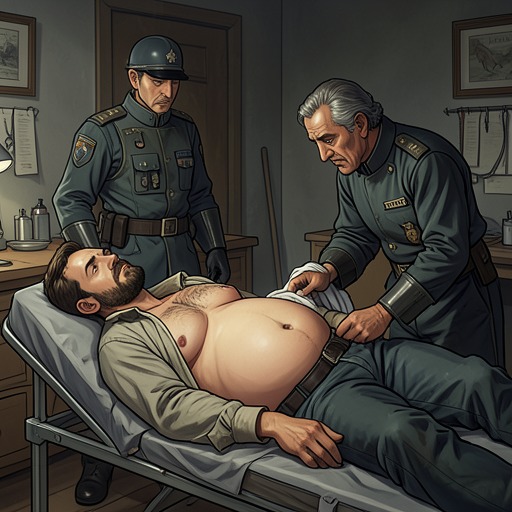
Kiss of the Spider WomanMolina's Sudden and Worsening Abdominal Pain in Prison is an episode in which an apparently temporary stomach complaint interrupts the cellmates’ exchange and becomes a question of whether Molina should go to the infirmary. The pain does not receive a diagnosis in the available scene. Its significance lies instead in its recurrence and escalation, and in the different risks that Molina and Valentin associate with seeking medical care.
Onset and Changing Symptoms
Molina first reacts with broken-off sounds of discomfort, then identifies his stomach as the source. He clarifies that the pain is higher up and sharply felt, rather than accepting Valentin’s initial suggestion that it might be appendicitis. The exchange establishes uncertainty from the outset: a specific cause is proposed, but Molina does not confirm it, and no examination or diagnosis follows in the scene.
Molina next attributes the pain to his nerves, recalling that he had been very nervous that day. For a moment, he thinks it is letting up. That apparent improvement proves unstable. Valentin observes that the pains are getting stronger, and Molina later describes their recurrence as increasingly severe. The progression from a localized complaint, through a brief easing, to stronger repeated pain gives the episode its movement without resolving what is wrong.
The symptoms also shift from pain to bodily urgency. Molina says he feels he has to go to the bathroom again. Valentin initially treats the problem as something that will not, by itself, send him to the infirmary; Molina replies that the episode is more than diarrhea and says Valentin should go if he were in Molina’s position. Their exchange shows that the disagreement is not simply over whether symptoms exist. It concerns how seriously to interpret them and what action they warrant.
The Infirmary and Political Risk
Valentin explains why he is especially reluctant to see a political prisoner end up in the infirmary. He recalls a comrade who became dependent on something administered there; in Valentin’s account, the treatment softened the prisoner and broke his will. He fears that care could weaken political prisoners’ resistance until interrogation made them say anything. The warning gives the infirmary a particular meaning in the prison: it is not presented as a neutral refuge, but as a place Valentin associates with vulnerability and possible loss of resistance.
Valentin distinguishes Molina’s situation from that of political prisoners and initially tells him that going to the infirmary would not cause the same harm. Yet when Molina’s symptoms continue, Valentin advises him to go. Molina resists by arguing that the authorities will not send him there for a little diarrhea; Valentin counters that the problem is more than that. Their positions therefore shift with the exchange: Valentin’s political warning does not erase his concern for Molina, and Molina’s skepticism about being admitted does not settle whether the symptoms merit care.
Interruption of the Cellmates’ Storytelling
The episode unfolds amid the cellmates’ narration of films. Molina says that he had sworn not to tell Valentin any more films and that breaking his promise will get him into trouble; Valentin replies that the pains are becoming stronger. The juxtaposition places a bodily crisis inside a conversation that has repeatedly turned to imagined scenes. Here the film story does not simply continue uninterrupted: the pain returns to the foreground, and the narration itself becomes something Molina may resume despite his earlier resolve.
That contrast is especially notable because the surrounding film descriptions rely on elaborate settings and performances. A Paris music-hall sequence evokes velvet, chrome, chorus girls, and a singer descending a staircase marked by lights. Later, Molina begins another account with a secluded house, a grand piano, and a blind pianist. Against such carefully composed scenes, the brief reports of pain and the practical argument about the bathroom or infirmary are abrupt and unresolved. The cell’s immediate physical circumstances keep breaking into the imagined worlds, rather than being replaced by them.
Consequences and Limits of the Episode
The episode establishes a worsening pattern and a disagreement about seeking care, but it does not state that Molina enters the infirmary, receives treatment, or learns the cause of the pain. Nor does the brief improvement at the beginning amount to recovery: Valentin’s later warning and Molina’s renewed urgency point in the opposite direction. The available scene ends with the question of how to respond still active.
The episode also makes the decision legible through the prisoners’ unequal circumstances. Valentin weighs medical care against the danger he associates with weakening political resistance; Molina focuses on whether his symptoms will be considered serious enough for admission. The two men do not share the same calculation, even as Valentin recognizes the worsening pain. In this way, the incident joins bodily uncertainty to prison life without converting that uncertainty into a confirmed diagnosis or outcome.